


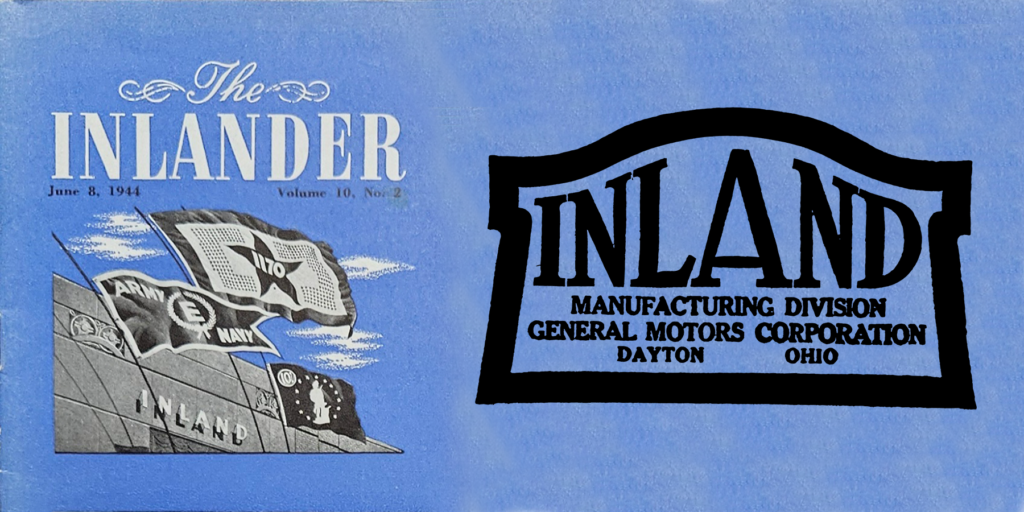

Inland Division of General Motors
How Inland Became the Principal Manufacturer of the U.S. M1 Carbine
Introduction
Among the ten prime contractors that produced the U.S. Carbine, Caliber .30, M1 during the Second World War, Inland Division of General Motors emerged as the largest and most influential manufacturer. Though it had no prior history as a complete firearms producer, Inland’s industrial capacity, engineering discipline, and ability to coordinate mass production positioned it at the center of one of the most successful small-arms programs in American history.
By war’s end, Inland had produced approximately 2.6 million carbines—over 40 percent of total wartime output—making it the dominant contributor to the Light Rifle Program.
From Automotive Components to Military Arms
Founded in 1922 in Dayton, Ohio, Inland was originally a General Motors division specializing in steering columns and automotive components. By 1940, Inland was already a precision manufacturer accustomed to tight tolerances, complex machining, and high-volume production—skills directly transferable to firearms manufacture.
When the U.S. Army adopted the M1 Carbine in October 1941, Ordnance faced an urgent challenge: no single traditional firearms manufacturer could meet projected demand. The solution was to recruit large industrial firms with scalable machining capability. Inland was ideally suited.
Crucially, Inland did not merely assemble parts—it produced receivers, barrels, and major components in-house, establishing it as a fully integrated prime contractor rather than a limited assembler.
Selection as the Primary Contractor
Inland became the first company to receive a production contract for the M1 Carbine in 1941. Several factors explain this early trust:
- Existing Relationship with Ordnance
General Motors divisions were already participating in defense production planning.
- Immediate Industrial Capacity
Inland possessed large-scale machining infrastructure capable of rapid retooling.
- Engineering Management
GM’s structured production systems allowed Inland to implement standardized tooling, inspection, and documentation procedures faster than many smaller firms.
Because of this readiness, Inland began pilot production earlier than most other contractors and established many of the initial production standards that later manufacturers followed.
Establishing Production Standards
As the earliest large-scale producer, Inland played a foundational role in refining:
- Receiver heat-treatment protocols
- Barrel production techniques
- Inspection gauges and tolerances
- Assembly-line workflow optimization
- Interchangeability standards
In practical terms, Inland helped transform the Winchester prototype into a mature, mass-producible military arm.
The Ordnance Department relied heavily on Inland’s engineering data to guide secondary contractors such as Underwood, National Postal Meter, and IBM. Inland’s early production runs effectively became the baseline against which other manufacturers calibrated their processes.
Volume and Scale
Between 1942 and 1945, Inland produced roughly 2.6 million carbines. This staggering output was achieved through:
- Multi-shift wartime operation
- Extensive subcontracting networks
- Female and newly trained wartime workforce integration
- Continuous tooling improvements
At peak output, Inland was producing thousands of carbines per day.
Its production totals exceeded those of Winchester itself—the original designer—cementing Inland’s position as the program’s industrial backbone.
Technical Contributions and Refinements
Inland’s importance extended beyond quantity.
Introduction of Improvements
As combat feedback emerged, Inland incorporated:
- Improved rear sights
- Strengthened operating slides
- Modified bolt designs
- Type III barrel bands with bayonet lug (late war)
M2 Carbine Development
Inland was the principal developer and first major producer of the selective-fire M2 Carbine in 1944–45. This version added automatic capability, marking a significant evolution of the platform.
M3 Infrared Carbine
Inland also played a key role in producing the M3 Carbine, fitted with early infrared “sniperscope” night-vision equipment—one of the first operational night-fighting small arms in military history.
These contributions placed Inland at the center of the carbine’s technological maturation.
Workforce and Wartime Mobilization
Inland’s Dayton facilities became a model of wartime industrial mobilization. Thousands of workers—many of them women entering industrial labor for the first time—operated precision equipment around the clock.
The transformation from automotive components to small arms within months demonstrated the flexibility of American industry under wartime pressure.
Dayton, Ohio became synonymous with carbine production, and Inland’s output supported Allied forces in every major theater of war.
Why Inland Became the Most Important Manufacturer
Inland’s central importance rests on five pillars:
- Largest Production Volume – Over 40% of all M1 Carbines.
- First Major Production Contractor – Established early standards.
- Technical Refinement Leader – Integrated design updates efficiently.
- Developer of Advanced Variants – M2 and M3 models.
- Industrial Coordination Hub – Supported standardization across multiple contractors.
While Winchester provided the winning design, Inland ensured that the design could be produced at the scale required for global war.
Historical Legacy
The Inland Division’s role in the M1 Carbine program stands as a case study in American industrial mobilization. It illustrates how a non-traditional firearms manufacturer became the largest small-arms producer of a critical wartime weapon in just a few years.
Above is a original copy of the proposal from Inland to manufacture the M1 Carbine